Why we need Segger Signature server
What the SEGGER Signature Server Hardware Key Actually Changes
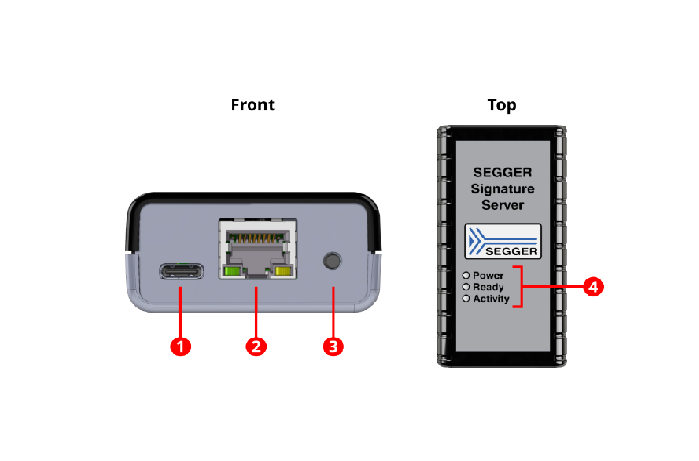
This is the Signature Server hardware — the physical device that keeps the private key secure in development and in production.
The SEGGER Signature Server hardware key is a dedicated appliance built for one job: it generates and holds the private signing key so the key never has to leave it.
A developer doesn’t keep the private key on their machine anymore. They authenticate to the server and ask it to sign a firmware hash. The server signs internally and returns only the signature. The key itself never gets exported, never touches a build machine, and never sits anywhere someone could copy it.
This changes the worst case entirely. Without it, one compromised laptop can leak the key that secures every device we’ve ever shipped. With the SEGGER Signature Server hardware key in place, a compromised laptop exposes at most one person’s login credentials. We can revoke and rotate those without touching the signing key, and without re-keying a single device already in the field.
One clarification up front: despite the name, this isn’t a server in the usual sense. It’s not software running on a network somewhere. It’s a physical hardware box — you plug it in, and the key lives inside that box, on that desk, in that locked room. Nothing about it involves the cloud or a remote data center. That’s the whole point: the key stays on hardware we control and can physically secure, not on a machine exposed to the internet.
Why the SEGGER Signature Server Hardware Key Matters for Us
- The key is permanent. We generate it once, before our first release, and use it for the product’s entire life. We can’t fix it later. Every device we’ve ever shipped trusts it.
- The manual alternative is fragile. Without it, we’d manage backups by hand. SEGGER recommends 3 copies, on 2 different media types, with one stored offsite. That’s a small key-custody program with no safety net.
- It separates roles, not just storage. Device Owners and Administrators manage keys. Release Managers use them to sign. Without it, whoever holds the file can do both, with no way to scope or audit access.
- This is a field risk, not just a code bug. A forged update that looks genuine isn’t something we patch later. It’s a security incident on devices customers already own. Once we lose trust in that key, we can’t get it back.
One more thing worth knowing: the SEGGER Signature Server hardware key doesn’t sign individual devices — it signs firmware images. One signed release flashes onto ten units or a hundred thousand the same way, so production volume barely touches how often we’d use it. And per SEGGER’s own Field Applications Engineer, it isn’t locked to emBoot-Secure’s signing format either. The same box can protect a private key for ST’s X-CUBE-SBSFU, a different bootloader, or a custom signing setup — in development and in production alike.
What It Doesn’t Solve
The SEGGER Signature Server hardware key protects the key we use to sign firmware on our side. It says nothing about whether an attacker with physical access to a device in the field can extract secrets from the chip itself. That’s a separate problem, one we’d address through the target hardware’s own protections: readout protection, secure boot regions, or a hardware secure element. We’d evaluate those independently. It closes the manufacturer-side gap. It doesn’t make the device itself tamper-proof.
Bottom Line
We already rely on cryptographic signing to keep unauthorized firmware off our devices. Right now, a password on a file is all that protects the key that guarantee depends on. The SEGGER Signature Server hardware key removes that single point of failure. The cost is small next to the alternative: rebuilding trust across every device we’ve shipped if that key is ever compromised.